
Quick Summary: NJ.com reports a 22% jump in small business sales listings in New Jersey in early 2026, driven by boomer owners retiring and rising commercial property taxes. About 28% of NJ business owners are reaching retirement age this year. A buy-sell agreement funded by life insurance protects your partners, family, and employees — and avoids a forced sale at a fraction of your business's true value.
Why Buy-Sell Life Insurance Is a Must for NJ Business Owners Right Now
I've talked with NJ business owners from Jersey City to Cherry Hill — and the pattern is always the same. Most have built something real: a loyal customer base, reliable employees, years of sweat equity. But when I ask about their succession plan, the answer is usually silence.
The NJ Small Business Development Center's Q1 2026 data shows 3,200 firms across the state without a succession plan — concentrated in manufacturing and retail in areas like Newark and Camden. Whether you run a Trenton auto shop or a Cherry Hill restaurant, this gap is a real financial risk to everything you've built.
A buy-sell agreement is a legal contract between business partners. Each partner is covered by a life insurance policy on the others. If one partner dies, the surviving partner uses the insurance payout to buy out the deceased partner's share at a pre-agreed price — giving the family fair value and the surviving partner full ownership, cleanly and quickly.
Why it matters for NJ specifically: NJ's estate tax exemption sits at $2 million. A business valued above that threshold can trigger significant estate taxes on ownership transfer — meaning the family could owe taxes on an asset they can't easily liquidate. A properly structured buy-sell agreement, funded by life insurance, keeps the transfer clean, tax-efficient, and dispute-free. NJ Business Journal has documented cases in Middlesex County where businesses sold at 50–70% below market value because no agreement was in place.
Real NJ Cases: What Happens Without a Buy-Sell Agreement
These aren't hypotheticals. They're the kinds of situations that happen across Central NJ regularly — and they're completely preventable.
Newark Warehouse: $800,000 Loss and 25 Jobs Gone
Two equal partners ran a family warehouse in Newark's Ironbound district. When one partner passed away with no buy-sell agreement in place, the surviving partner and the deceased's estate entered a dispute over the business's value.
Estate taxes took 35% of the $1.5 million business value. The survivor had to borrow at 7% interest to buy out the heirs. After two years of legal disputes and financial strain, the business folded — taking 25 jobs with it in a community already dealing with a 4.2% unemployment rate.
A $1.5 million life insurance buy-sell policy at roughly $15,000–$20,000/year in premiums would have prevented $800,000 in losses and saved 25 livelihoods.
Camden Retail Chain: $3M Business Liquidated for $1.2M
A three-store retail chain in Camden was worth $3 million when the owner passed away without a succession plan. His children inherited ownership stakes but had no interest in running the business — and no mechanism to sell fairly to the operating partner.
Without a buy-sell agreement, the only exit was a forced liquidation. The business sold for $1.2 million — 40% of real value. Taxes took another $400,000. Long-term employees lost their jobs, and a community business of over a decade disappeared.
A buy-sell agreement funded by life insurance could have paid $1.5 million tax-free to survivors — covering the full buyout at market value and keeping the business alive.
The NJ Business Journal documented 15 similar closures in Q1 2026 alone — most involving small businesses with under 50 employees, no key person coverage, and no succession plan in place.
How Life Insurance Funds Buy-Sell Agreements
The mechanics are simpler than most business owners expect. Here's the most common structure — a cross-purchase agreement:
- Each partner takes out a life insurance policy on each of the other partners.
- The buy-sell agreement sets the buyout price in advance — typically tied to a current business valuation.
- When a partner dies, the surviving partner receives the insurance payout.
- The survivor uses that payout to purchase the deceased partner's ownership share from the estate.
- The family gets fair cash value. The business continues without disruption or debt.
Construction Firm: Two Partners, $4 Million in Coverage
A Woodbridge construction firm had two equal partners, ages 55 and 58. Each took out a $2 million policy on the other. Annual premiums totaled $18,000 — split between the partners.
The buy-sell agreement locked the business value at $4 million. If either partner passes, the survivor receives $2 million tax-free — enough to buy out the deceased partner's share without debt, forced sale, or loss of operational control.
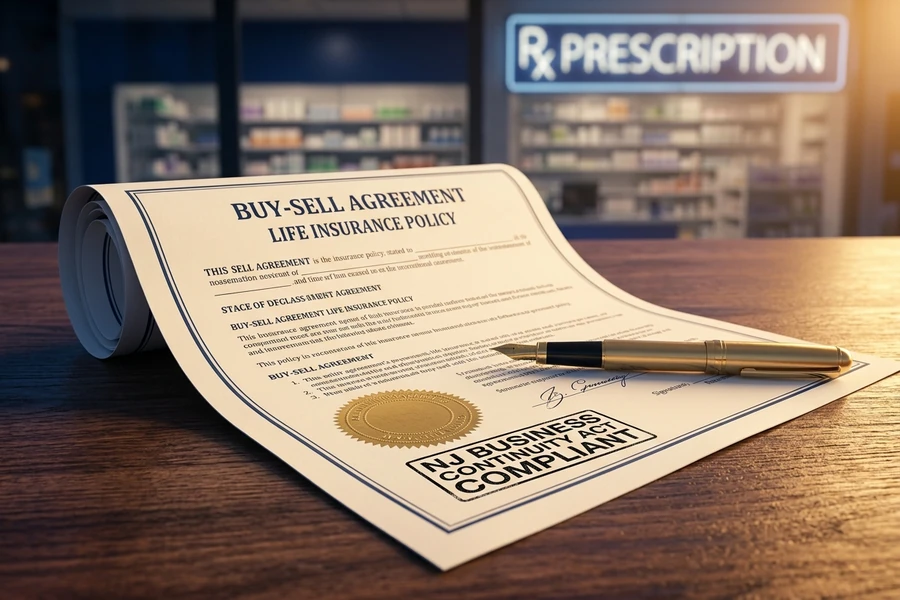
How a cross-purchase buy-sell agreement works — each partner's policy funds the other's buyout.
Dental Practice: Clean Handover, 18 Staff Protected
Two dental partners in Cherry Hill each held $1 million policies on the other. Combined premiums: $12,000 per year. When one partner passed away, the payout funded a smooth ownership transfer. The practice kept running, 18 staff members kept their jobs, and patients were never disrupted. Probate was bypassed entirely.
Tax efficiency note: Life insurance death benefits paid through a properly structured buy-sell agreement are generally received income-tax-free. For NJ businesses valued above the $2 million estate exemption, this structure also helps avoid estate tax on the ownership transfer. Always coordinate with a qualified NJ business attorney and accountant — Kevin handles the insurance side.
Key Person Insurance and Group Life — Additional Layers of Protection
A buy-sell agreement protects your ownership structure. But there are two additional tools every NJ business owner should consider alongside it.
Key Person Insurance
Key person insurance is a policy owned by the business on a critical employee whose loss would materially impact revenue or operations. The business pays the premiums and receives the death benefit.
$500,000 Policy on the Sales VP
A Jersey City startup placed a $500,000 key person policy on their VP of Sales. When the executive passed away unexpectedly, the payout covered six months of revenue replacement and hiring costs — preventing a cash crisis at the company's most vulnerable moment.
Group Term Life — Retention During Transitions
Group term life insurance provides a basic death benefit — often $50,000 — to each employee, typically at low or no cost to employees. It's one of the most cost-effective benefits a small NJ business can offer, and it becomes particularly valuable during ownership transitions when employee confidence needs reinforcing.
Your Next Steps
Getting a buy-sell agreement funded by life insurance in place requires coordination between your insurance agent, your attorney, and your accountant. Here's the order of operations:
- Get a business valuation. The NJ Small Business Development Center offers free valuation tools. You need a current number before structuring a policy correctly.
- Talk to Kevin about the insurance side. He'll quote policies for each partner, compare carriers, and structure coverage to fund the buyout at today's value. Quotes are ready within 48 hours — no obligation.
- Work with a business attorney to draft the agreement. Kevin handles the insurance. Your attorney drafts the legal buy-sell contract that references the policies.
- Integrate with your estate plan. Your accountant ensures everything is structured tax-efficiently given your entity type, value, and ownership split.
Important: Kevin is a licensed insurance agent, not a tax advisor or attorney. He handles the insurance component of your buy-sell strategy. For the legal agreement and tax structure, always work with a qualified NJ business attorney and CPA.
Frequently Asked Questions
A buy-sell agreement funded by life insurance handles ownership transfer between partners when one dies — it protects the business structure and the partners' families. Key person insurance is owned by the business on a critical employee and covers the financial impact of losing someone whose skills or revenue generation are essential to operations. They solve different problems and many NJ businesses need both.
The buyout price is established in the legal agreement — typically set at drafting and reviewed periodically as the business grows. Methods include a fixed dollar amount, a formula based on earnings, or an independent appraisal. It's critical that the insurance coverage amount matches the buyout value. Kevin will flag when coverage should be updated as your business grows.
Often yes — approval rates run around 95% for applicants under age 70. Kevin works with multiple carriers and knows which ones are more favorable for specific health histories. The earlier you address this, the more options and better rates you'll have access to.
With term life policies, if neither partner passes during the term, premiums aren't recovered — but the protection was real every year it was in force. Some business owners choose permanent policies (whole life or IUL) for buy-sell funding, which builds cash value even if the death benefit is never paid. Kevin will walk you through both options based on your partners' ages and goals.
The insurance portion — quotes, application, and underwriting — typically takes 2–6 weeks. The full process including the legal agreement is typically 4–8 weeks. Kevin can have preliminary quotes ready within 48 hours of your first conversation.